External Forces At Play in our Digital Future
Interviewed by State of Open Con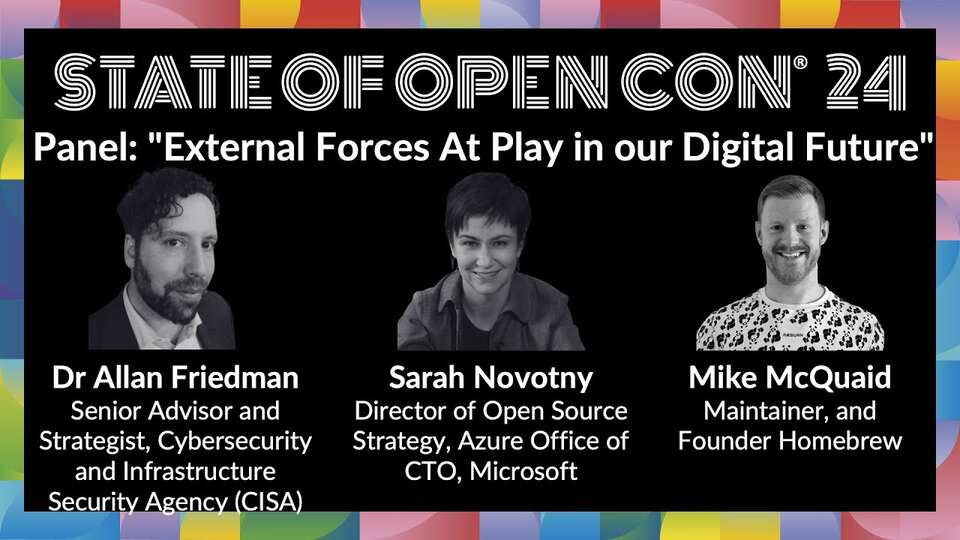
https://www.youtube.com/watch?v=6sRAUZd2TCQ
Show transcript
- 0:00 About a year ago, I started talking about whether open source was going to fail, because
- 0:09 clearly we've won. 96% of all software stacks are dependent on open source. 76% of that
- 0:16 software is open source, according to Sonatype's report last year. And the question isn't whether
- 0:22 we've won. The question is, what have we won? Have we won the war or a battle? Open source
- 0:29 is under pressure, there is a lot of friction. And across the next two panels, and I'm going
- 0:34 to apologize, nobody got the slides wrong, it was me. So we should have had Bruce after
- 0:38 the first panel. So everybody running around me is rejigging my mistake, so bear with us.
- 0:44 The first panel is going to look at the external pressures coming in an open source. And the
- 0:50 second panel is going to look at the internal friction within our communities. So it's a
- 0:56 pleasure to welcome to the stage the first three panelists, Dr. Alan Friedman, who's a senior
- 1:03 advisor and strategist at the Cybersecurity and Infrastructure Security Agency in the US,
- 1:09 CISA or CISA, I'm never sure which way to pronounce it. Sarah Novotny, director of open source strategy
- 1:15 in the Azure office of CTO at Microsoft. And Mike McCade, who's the project leader and maintainer
- 1:21 of homebrew and the CTO and co-founder of work brew.
- 1:25 S-Bomb, S-Bomb, S-Bomb, S-Bomb.
- 1:29 S-Bomb, S-Bomb, S-Bomb, S-Bomb, S-Bomb, S-Bomb.
- 1:38 Now you may be thinking, why is she playing that? We've got the theme, the music's British.
- 1:44 Why would she be playing Tom Jones S-Bomb? So since the term S-Bomb was coined, that song
- 1:52 has been in my head, and now it's in yours.
- 1:55 Well done.
- 1:59 As I said, open source, we've won external frictions. External frictions, regulation, policy,
- 2:09 security, supply chain, and being a maintainer. Being a maintainer, external, we'll get to it.
- 2:17 Alan, you work in policy and regulatory. You work with the US government department. Tell
- 2:24 me, why are government departments across the globe suddenly looking at open source?
- 2:31 Well, as we've already established, open source won. We took over the software world, and software
- 2:38 runs every aspect of our lives. So I come from the security world. And in security, when we
- 2:45 talk about saving lives, it's important. And you get to sit up a little straighter, your voice
- 2:53 drops a couple octaves, and you get a couple extra zeros at the end of your budget.
- 2:58 So CISA is the Cybersecurity Infrastructure Security Agency. We focus on responding to threats.
- 3:04 We are a civilian agency, responding to threats to the American government and the American population,
- 3:09 building out how we're going to respond and be resilient to future threats.
- 3:16 And so a lot of this is saying, if the software that we're worrying about is not just proprietary,
- 3:23 if it's open source, we need to understand what are the risks, not just at the technical
- 3:29 level, but at the very core human level of how do we make sure that our trains run, that
- 3:35 our water gets delivered, that lives are safe.
- 3:38 So, Sarah, when you look at that from the context of a major company, how are you managing the
- 3:45 interactions with these policies, with these regulations that folks like Alan are starting
- 3:50 to bring into open source?
- 3:51 The answer is we're learning. We're always learning in this space, particularly because some of
- 4:00 the regulations aren't even fully formed at this point. Recently, there was the CRA in Europe,
- 4:07 and it speaks to compliance to standards. Oh, by the way, we're going to figure those standards
- 4:12 out. So that's all still coming. So the answer here is just like open source, just like good
- 4:19 developer conferences. It's all just-in-time delivery at the moment. We're working in the US,
- 4:25 particularly against an executive order from the US government also, saying that we need to secure
- 4:31 our supply chains in a meaningful way. All of this leads to the point that software and open source
- 4:37 specifically have won. We run the world in this way. And without understanding, I love the way you framed
- 4:45 it as risk. I gave a talk to a bunch of investment bankers at one point,
- 4:49 who are like, how do we evaluate companies? And I said, ask them about their open source dependencies.
- 4:55 They're like, but they're proprietary software. And I'm like, ask them about their open source
- 5:00 dependencies. Do they know how many dependencies do they have? Do they know where they are?
- 5:05 Do they know which are their critical risk points? Which are the ones that have existing existing
- 5:13 CVEs against them? Are they able to articulate whether the software they have or are using
- 5:21 is even actually a risk if it has an open CVE? This is the VEX work that's happening in a number of places,
- 5:28 trying to find a way that businesses can rationalize the software that they develop because Lord knows,
- 5:37 when was the last time any of you wrote a math library? It's been a while. So we need to
- 5:44 rationalize and understand as companies where we're using open source software. Not many companies can
- 5:50 actually give you a good articulate answer in this. The larger companies I feel are doing a better job and
- 5:56 that's still trying to get our arms around an amoeba. So we're trying very hard and continuing to learn the
- 6:03 whole way that we're doing this. But that means we work with you in the communities, in open source,
- 6:09 in standards, in government to figure out how we can make sure that our software is safe and secure,
- 6:17 well documented and engages with our users in a way that they can understand.
- 6:24 So Sarah, if that's a lot of work for a company of the scale of Microsoft, obviously you have a lot
- 6:32 of utilization. But if that's a lot of work for you, it begs the question, how does a maintainer cope
- 6:39 with the policy and the regulation that is being imposed upon them, whether it's in the White House
- 6:46 executive orders, the European Cyber Resilience Act, which Sarah just mentioned, with a potential of 44
- 6:52 standards being put in place to allow it to work? Mike, how are you going to cope with that?
- 6:58 Well, one of the nice things is because I'm a maintainer who does not live in the United States or,
- 7:05 unfortunately, the EU. Thankfully, as long as I'm happy to just not travel to those places,
- 7:11 I don't have to worry too much. But more seriously, I think there is this underlying tension we have
- 7:16 right now where there's a lot of regulations that are in place that make sense, that don't really
- 7:21 affect me too much. Software patents is the one that comes closest to being like an actual day-to-day
- 7:28 annoyance. But in the longer term, we see a need for kind of regulation around software and AI. And
- 7:35 you know, when I put my kind of citizen paying attention to politics hat on, it's very easy to see
- 7:41 why there's a move to do these things. But I think where we need to be really careful is people
- 7:46 understate in open source how much of the work is just done by volunteers in their evenings and weekends.
- 7:51 So Homebrew, the project I work on, I think most people who are doing development on a Mac
- 7:56 are likely to interact with Homebrew in some way or form. We kind of, our estimates, based on our
- 8:01 analytics, so we've got about 30 million users. We've had... How many users? About 30 million.
- 8:07 30 million. Yeah.
- 8:12 So this is all done. We have about 10,000 people who have contributed over the years, but only 30
- 8:19 people are kind of actually making sure that Homebrew is running. And none of those people, I guess,
- 8:25 except maybe me now, now that I've started my own business doing some of this stuff, none of those
- 8:30 people are actually paid a day job salary to do that. So what happens if we make this work for those
- 8:36 people dramatically harder through regulations? What happens if we put people in a situation where
- 8:41 they're worried about legal risk here? There's a real chance of having a chilling effect where people
- 8:45 are going to say, "Well, why would I spend my evenings and weekends working on stuff that's used
- 8:50 and relied upon by many, many people where I'm not getting paid or getting, you know, tiny amounts
- 8:56 of money for this as like a sort of donation if someone's going to turn around and sue me for doing
- 9:01 that?" So I think we need to be really careful when we're doing this stuff. Bruce had some great points,
- 9:07 I thought, in the talk earlier about we need to think carefully about what we're going to do with
- 9:12 the big players, the Google, the Microsoft, the whoever, who have big budgets, who have the money
- 9:17 to be able to comply with regulations, and what are we going to do with the small players? What are we
- 9:20 going to do with the people who sit down in their house in their evening and decide to make an open
- 9:25 source library that then many millions of people may rely on in five or ten years? Because we don't want
- 9:30 those people to decide this is too risky, I'm going to go play World of Warcraft instead.
- 9:35 Yeah, and this is a really important conversation because I spoke to a lord, as you do, I spoke to a lord
- 9:43 recently about liability and risk and he was surprised when I expressed the view as a lawyer of 25 years
- 9:51 who spent the last 15 in open source that we know that regulation applies to open source software in our
- 9:58 community. Nobody's surprised by that, regulation trumps licensing and what we need is regulation that's
- 10:06 agile, that's flexible and that recognizes the kind of people who are maintainers and building these
- 10:11 projects and building that best innovation for the rest of the world. So Mike, just to finish that
- 10:19 conversation, maintainers, something it took me a long time to work out, the maintainer responsibility
- 10:25 doesn't flow with your employer, right? It flows with the individual. No, I mean a lot of the time
- 10:30 maintainers, as I mentioned, they're doing this stuff in their evenings and weekends. We have an
- 10:35 increasing number of maintainers, which is a good thing, who are doing that nine to five, Monday to
- 10:39 Friday, being paid by their employer to maintain an open source project. So those folks have obligations to
- 10:45 their employer. Generally, most companies are not happy to just pay you for no reason whatsoever. If you find
- 10:50 one, let me know because that would be great. But most of these maintainers who are doing it in their
- 10:54 spare time, essentially, they don't really have any obligations to the community that they work on.
- 10:59 And if you look at most open source licenses, they kind of state this pretty clearly, where
- 11:04 essentially, I wrote a blog post about this a few years ago, that maintainers like the title,
- 11:09 pretty much everyone else hated it, called open source maintainers owe you nothing. Because if you read
- 11:13 through an open source license, it effectively says that there's no guarantee this software will work. There's no
- 11:19 guarantee the software will even do the things that we say it will. And even if the software were to break
- 11:23 on purpose and cause you damage, you agree in using the software that you do not hurt the maintainer
- 11:29 liable in any form. As Amanda said, when that kind of comes to regulatory frameworks, there's a bit more
- 11:36 of a blurred line there. I think if I deliberately made homebrew do something in a way that was negatively
- 11:40 impactful on people, I suspect there would be legal implications involved there, even if the license says otherwise.
- 11:47 But I think it is important to note that the bulk of people who are doing this stuff,
- 11:51 even if they do it in some of their working hours, if they're putting it out in their own name,
- 11:55 if the copyright is held by them, then it's up to them and their relationship with the open source
- 12:00 community to manage and not something that their employer can or does do for them.
- 12:05 And what the licenses generally say is that you exclude liability and some of them say to the
- 12:10 fullest extent permitted by law because the law trumps the license. And that's the way that
- 12:15 the world of regulation works. Now, I know both Sarah and Alan are desperate to jump in on that.
- 12:20 I'm going to let Alan go first because we've waited longer to hear more from him.
- 12:23 You know, one of the big challenges is how can policy makers understand
- 12:31 the developer perspective, the maintainer perspective. And I think there are a couple of
- 12:38 lessons that we can take from the past. So again, I come to the security world and in the bad old days,
- 12:45 there was a constant fight between security researchers who would point out that security
- 12:49 was terrible and the people who sold commercial software, who use the government to try to throw
- 12:56 those people in jail. And what's pretty incredible is in the last 10 or 15 years, we've solved that problem.
- 13:05 The last couple of years at the famous Defcon hacker conference, governments from all over the world
- 13:11 have gone there to listen, to learn, and to demonstrate. We get hackers. They're the immune
- 13:17 system of the internet. And so there are ways that we can build that kind of collaboration.
- 13:22 But it's sort of still there. And there's the as is model. There's a great blog post by a French
- 13:30 developer last year, Thomas de Pierre, who said, was titled, I am not your supply chain. And it really
- 13:36 should have had an expletive in it. I am not supply chain. And I get it, and totally makes sense.
- 13:44 But there's also a pretty amazing project called Zephyr, which is a real time operating system,
- 13:50 open source. And the vision is that that should underpin some of our most important systems in the
- 13:55 world. And if we want that to be in that environment, and we want it to be that important, then that
- 14:04 community is going to have to continue the great work they're doing of making sure that there's
- 14:08 maintenance, that there's updates, that they can respond, and also respond negatively to be able to
- 14:15 communicate downstream, hey, this doesn't affect us, carry on. All of those things are what downstream
- 14:22 users of open source need. Sarah? I wanted to touch on maintainers and how they intersect with
- 14:29 corporations, because that is an open problem today. Because how many demand letters have you gotten
- 14:36 recently? Not from companies going, I need I need to, I need your s bomb now. And it's like, well, I don't
- 14:41 know you that. Yeah, we we get a few of those. I'm quite good at saying no in all areas of my life.
- 14:49 So, so we we send we corporations errantly, misunderstanding the license, misunderstanding the
- 14:56 social contracts of, of open source, send demand letters, we, we say we want someone to contribute
- 15:04 to open source. So we hire an open source developer, but then our business choices change. And the hiring
- 15:10 that person to work on open source is only as durable as the manager, or maybe the VP who said,
- 15:17 yes, you can use half your time, yes, you can work all your time on open source. So we need things
- 15:24 like different ways of conceiving about maintainer roles in corporations, because being a maintainer
- 15:32 on a critical system, open SSL was a great example in Bruce's, in Bruce's kit, in talk. If we have a
- 15:39 critical dependency, if our customers have critical dependencies on this, there is good reason for
- 15:47 us to hire a maintainer to allow that maintainer to continue to work on this. And this is an uphill
- 15:53 battle in every company I've worked in, we we have maintainers who want to work. And yet, we want them
- 16:01 to we want they want to work on open source. And we have social contracts within open source. So to your
- 16:08 point, maintainers, even if they are hired by a corporation, will maybe get their job shifted
- 16:14 slightly. And then because they're personally responsible to the open source community through
- 16:20 a social contract through a group that is larger than their company, they end up working on their
- 16:26 evenings and weekends, because maybe we didn't get as far during my day job, or I maybe my work has
- 16:32 changed. So we're still burning out open source maintainers, even when we pay them to work within
- 16:38 our larger corporations. This is an open problem. And no company can currently rationalize as well about
- 16:46 the social contract as an individual inside open source, as in competition with the corporate contract
- 16:52 of my employment. I think that that social contract conversation is a really important one. And we're
- 16:59 going to delve into that a bit more in the next panel when we talk about the internal frictions.
- 17:03 We've got about five minutes left in this panel. And we really want to try and open this conversation
- 17:11 up. Now I told you we're convening the global open tech community here because there were big discussions
- 17:17 to be had, big challenges to face. I didn't say we had the answers. So we are working on these answers,
- 17:25 we want to convene the conversation and we want to convene you the conversation. So
- 17:29 we will continue the conversation after this morning after today. And any of you who want
- 17:33 to engage on an ongoing basis should be in touch with us, and we will bring you together. But before
- 17:40 we wrap this external factor panel, we can take one possibly two questions if the panelists are quick
- 17:47 in answering. Does anybody have a question for the panel? Gentleman here, and then gentleman here,
- 17:53 assuming we can get to. Hi Amanda. I have a question. I'm actually quite worried that even homebrew is not
- 18:02 like small people working for free. So as individual contributors and community members,
- 18:07 how can we change that? How can we support you? We are not those big companies, although we work at some
- 18:13 of them. So what can we do? The only thing I can think of is championing this stuff inside of the
- 18:18 companies, recommending them to sponsor you. But that's as much as I think about it.
- 18:24 Thank you. So as individuals, what can we do? Mike probably should come to you with that first.
- 18:29 Yeah, thank you. I think that's what the first thing you've done already is demonstrating that you
- 18:34 care and saying nice things. And you'd be surprised how few people in open source say nice things. So
- 18:42 if you don't open an issue, whatever. But if you see someone today who you happen to know works on an
- 18:48 open source project you like, tell them, hey, I like this thing. Thank you for doing it. You'd be
- 18:53 surprised how much that helps motivate people. So that's a good start. And it's free, which is even
- 18:58 better. Another is just setting your expectations accordingly. And Sarah had some really good points
- 19:04 with kind of corporations that come along kind of making demands. And I think there's like,
- 19:09 there's a spectrum here. There's a where, you know, you may not be a corporation coming along and
- 19:15 demanding SOC 2 compliance for open source project. But you might be someone who is pretty grumpy that
- 19:20 they've hit this bug. And, you know, you're feeling angry and triggered or whatever, when you write your
- 19:26 issue report, and you start talking about how this open source project is a piece of bleep, and the code
- 19:31 quality is a piece of bleep, and blah, blah, blah, blah. Don't do that. Try and remember that you're
- 19:36 speaking mainly with people who are, as I say, often working in their evenings and weekends for fun,
- 19:41 trying to build this stuff for you. Just try and be nice, try and be friendly, try and be helpful,
- 19:45 do as much as you can to help yourself before you rely on other people to help you. And if you do that,
- 19:51 then open source will be better. And it will be easier for people who are doing this stuff in their
- 19:56 evenings and weekends to want to do it more. Alan, as somebody who's here representing a government
- 20:00 department, we don't want to alarm you with the evening and weekend thing, right? We want
- 20:05 to understand that there's millions and billions of dollars going into the ecosystem, perhaps not all
- 20:10 being channeled in the right direction. And that's something we need to work on. Comment from that
- 20:16 perspective. Sure. So you may not know this, but from a policymaker perspective, you're actually quite
- 20:24 exotic. There's very little that makes it easier and better for me to do my job in Washington than to
- 20:32 be able to give, begin a speech by saying, well, I spoke to a developer in London and they said,
- 20:38 here's a cool story. So if this is something that you've thought about and you're passionate about,
- 20:46 being able to think about your own narrative and communicate it in a way that someone else who
- 20:53 doesn't know your world can understand why it's interesting and important is very powerful. So
- 20:58 that's one of those human sides of things that policymakers and politicians like is to be able to
- 21:06 say, you know, Sue over here is worried about X. So I think that's one of the key things you as an
- 21:12 individual can do. And you can folks like open UK can help aggregate that and have those narratives
- 21:19 percolate up. And I would remind you of what I said to you earlier that we have the home office
- 21:24 and the department of science, innovation and technologies, AI teams who want to learn more
- 21:29 about open source. And they will be in the AI policy zone right in the basement at the very back
- 21:35 from one till two and two till three, both days, there's room for 40 people in the consultation room,
- 21:41 and they want to understand from you what open source is, how it works and how the whole AI
- 21:47 scene is being impacted. So I'm going to jump to the last question and take that to Sarah,
- 21:53 and then we're going to wrap this panel. Gentleman at the front. The mic, please. Down here.
- 22:05 That's okay. Thanks, Andy.
- 22:14 Can you hear me? Oh, can you hear?
- 22:15 Yep, Sammy Atabani. Question actually, regulations across different jurisdictions, which are very often
- 22:24 very conflicting. What can we do to help? I know Amanda mentioned the AI and government officials being
- 22:32 around, but it's really difficult to get aligned across the different jurisdictions. So I'll be
- 22:38 interested in your thoughts on that. I don't know if everybody heard that. And we're going to come to
- 22:41 Sarah and Alan very quickly to wrap this up. With differing laws and differing standards across the globe,
- 22:47 what can we do to make this simpler? Sarah? Thoughts? This is something where we have a unique opportunity
- 22:54 right now because as a community, we are seeing regulators ask us for our opinions on laws.
- 23:03 We are seeing regulators come to us and look for engagement about how to rationalize these things.
- 23:10 And generally governments are fairly good across the globe. Not great, fairly good at rationalizing and
- 23:16 trying not to make conflicting laws. But our opportunity today is to participate in this work to make sure
- 23:23 that these standards and the standard orgs that we know about, and generally, as Alan said, speak your
- 23:30 piece. The internet is there for democratization of sharing information. So write up what you think,
- 23:38 share it with your legislators, share it with the bodies that are convening discussions about what these
- 23:43 standards should be. And please participate. That's the best thing we can do right now.
- 23:48 Thank you. Alan?
- 23:51 Very briefly, one thing that can help is security is a giant, complex, multi-dimensional idea.
- 23:59 And so one thing is take your area, right? Whatever it is, if it's memory safety, if it's web app
- 24:08 security, take a pic and say, hey, here's a small thing. And then if we can package it,
- 24:13 in a way that we can then share it with, you know, folks in Brussels, folks in London, folks in
- 24:19 Washington, folks in Tokyo and Seoul, then that can be sort of fit into each national orientation,
- 24:26 but we can have those common security features. Yeah. Mike, I wasn't going to let you have the last
- 24:32 word, but I will. Cross border regulation. I don't know. This is not something I think about a huge
- 24:42 amount. But I guess, again, I would say just to anyone here who's involved with writing those regulations,
- 24:49 consider the little guy who may be impacted by this stuff and try to collaborate as the open source
- 24:58 community has collaborated around the world. You know, our team on homebrew, we just met together
- 25:03 yesterday. We have people from people who it's their first time leaving their home country. And the
- 25:08 first time they've done that has been to come and meet the other people they've been working on
- 25:11 with open source for a while. Like borders don't mean a whole lot to us in open source land,
- 25:16 which is why sometimes the regulations and the differences between borders are confusing.
- 25:20 Try and copy us a little bit more, try and work together across companies, governments, countries,
- 25:28 etc. And then we can have something a little bit more unified. We can all be happier and friendlier.
- 25:32 Mike, Sarah, Alan, thank you so much for joining us this morning.
- 25:46 Thank you.